
Author: Daniel Berry

E-bike Insurance Gap

E-Bike Insurance in Australia: The Coverage Gap That Could Cost You Thousands

Update — March 2026: Queensland E-Mobility Inquiry Recommends Major Reforms

A Queensland parliamentary inquiry tabled this month has made 28 recommendations that would significantly change how e-bikes and personal mobility devices are regulated in Queensland. The key changes proposed include:

  • Non-compliant e-bikes (those capable of exceeding 25km/h) to be reclassified as motorcycles or mopeds — requiring registration, a licence, and Compulsory Third Party (CTP) insurance
  • A minimum age of 16 for all e-bike and personal mobility device riders, with at least a Queensland Class C learner licence required
  • Footpath speed limits of 10km/h maximum for all e-mobility devices
  • Mandatory battery safety standards and stronger import controls
  • Police powers to seize and destroy illegal devices on a first offence

These are recommendations, not yet law — but the direction is clear. If you ride an e-bike in Queensland or have children who do, the insurance implications are significant and worth reviewing now. Speak to our team to understand how these changes may affect your coverage.

Article Summary:

This article addresses the critical insurance gap affecting Australian e-bike owners. Most riders don’t have liability coverage for accidents they cause, despite assuming their home insurance protects them. Using a real case study where a teenagers e-bike accident resulted in $5-10k in vehicle damage, this guide explains what coverage exists, common policy exclusions, and how to protect your family from unexpected financial liability.

Who this is for: E-bike and e-scooter owners, parents of teenage riders, families reviewing insurance coverage.

Key question answered: Does my insurance cover liability if I cause an accident on my e-bike?

Key Takeaways:

⚡ Quick Facts:

  • E-bikes and e-scooters often aren’t covered under standard home and contents insurance
  • Personal liability insurance for e-bikes is frequently excluded from home policies
  • Some insurers specifically exclude electric bikes; others haven’t updated policies yet
  • Standalone e-bike insurance is available but most owners don’t know it exists
  • A single accident can result in damage claims of $5,000 to $10,000+

Table of Contents:

  1. What is E-Bike Insurance?
  2. The E-Bike Boom: Great for the environment, risky for your wallet
  3. A real-world warning: The $10,000 accident
  4. The growing E-bike problem
  5. The coverage question: Are you protected?
    • Standard Home & Contents Insurance
    • Motor Vehicle Insurance
    • Standalone E-Bike Insurance
  6. What’s actually at risk?
  7. Who’s most at risk
  8. What you need to do right now
  9. The complexities of E-Bike insurance
  10. Beyond Insurance: practical safety steps
  11. Don’t wait for an accident to find out you’re uninsured
  12. How Dudgeon Berry Insurance Group can help
  13. In summary
  14. Frequently Asked Questions

What is E-Bike Insurance?

E-bike insurance is a type of insurance coverage that can protect electric bike and e-scooter riders from financial liability when they cause injury to others or damage to property. While some home insurance policies may include personal liability coverage for e-bikes, many specifically exclude motorised personal mobility devices, leaving riders financially exposed in the event of an accident.

Electric bike insurance typically covers:

  • Liability protection if you cause an accident that injures someone or damages property
  • Theft and damage to your own e-bike
  • Personal accident cover for injuries you sustain while riding

Understanding whether you have adequate e-bike liability coverage is essential, as Australian law holds riders personally responsible for accidents they cause.

The E-Bike Boom: Great for the Environment, Risky for Your Wallet

E-bikes and e-scooters have transformed how Australians get around. They’re eco-friendly, economical, and increasingly popular with everyone from school kids to commuters. According to NRMA’s Open Road, the booming e-bike industry in Australia will continue its meteoric rise in 2026, with industry experts tipping sales to approach $1.3 billion nationally.

But while sales are soaring, there’s a critical question most owners haven’t asked: What happens if I cause an accident?

At Dudgeon Berry Insurance Group, we’ve recently seen this scenario play out in real life, and it’s a wake-up call for every family with an e-bike in the garage.

A Real-World Warning: When E-Bike Accident Liability Becomes Personal

Here’s what happened to one of our clients just recently:

A teenager was riding their e-bike along the street when they became distracted and rode straight into the back of a parked car. The teenager was taken to hospital. The vehicle sustained serious damage with estimated repair costs between $5,000 and $10,000.

The car owner’s motor vehicle insurer will repair the damage under their comprehensive insurance policy, but here’s the problem: they’ll almost certainly pursue the teenagers family for reimbursement of those costs through a process called subrogation.

When we advised our client to check whether the family had any coverage, the answer was devastating: nothing. No e-bike insurance. No personal liability insurance for e-bikes under their home and contents policy. No protection whatsoever.

That family is now potentially facing a five-figure bill – all because of a moment’s inattention on what seemed like a harmless ride around the neighborhood.

The Growing E-Bike Problem

This isn’t an isolated incident. Anecdotal evidence and industry discussions suggest e-bike and e-scooter related incidents are becoming more common:

Increased safety concerns – Healthcare professionals and insurance brokers are reporting more frequent discussions about e-bike and e-scooter injuries.

Pedestrian safety concerns – Riders (particularly young riders) traveling at speeds up to 25km/h on footpaths can create hazards for walkers, elderly residents, and families with young children.

Property damage incidents – Insurance claims for incidents where e-bikes collide with vehicles and property appear to be increasing as e-bike ownership grows.

Serious accidents – Fatal accidents involving e-bikes and e-scooters have been reported in Australian media, prompting discussions about regulation and safety awareness.

The key concern is this: most e-bike owners have never considered whether they have liability coverage if they’re at fault in an accident.

The Coverage Question: Are E-Bikes Covered by Home Insurance?

When it comes to e-scooter liability insurance and electric bike coverage, the answer is complex and often surprising.

Standard Home & Contents Insurance

Many people assume their home and contents policy provides automatic liability coverage for e-bikes. This assumption is frequently incorrect.

Standard e-bikes often fall into a “gray zone” in home insurance policies. Some insurers classify them as motorised vehicles and exclude or limit coverage from personal liability protection, while others treat them as personal property similar to bicycles. This inconsistent classification creates significant confusion for e-bike owners.

As e-bikes have become more popular, insurers have been responding to emerging risks in different ways. Some home insurers now:

  • Specifically exclude e-bikes and motorised personal mobility devices from personal liability coverage
  • Have updated their Product Disclosure Statements in recent years to address e-bike risks
  • Require specific disclosure about e-bike ownership and may charge additional premiums
  • Haven’t yet addressed e-bikes in their policy wordings, creating uncertainty about whether coverage exists

The critical issue? Policy wordings vary significantly between insurers, and what’s covered by one might be explicitly excluded by another.

Motor Vehicle Insurance

E-bikes generally don’t fall under motor vehicle insurance policies. Most consumer e-bikes that comply with standard power limits (250W motor, 25km/h maximum assisted speed) aren’t classified as registrable motor vehicles under state transport regulations and therefore aren’t covered under standard motor vehicle policies.

Standalone E-Bike Insurance

Specialised electric bike insurance is available in Australia, but awareness and uptake remain low. Many owners don’t realise this dedicated coverage exists, or they assume they’re already adequately covered elsewhere.

What’s Actually at Risk?

If you or a family member causes an accident while riding an e-bike without adequate coverage, you could be personally liable for:

Property damage – Vehicles, fences, buildings, shopfronts, or other property you collide with. Typical vehicle repair claims range from $3,000 to $15,000 depending on damage severity.

Personal injury – Medical costs, lost wages, ongoing care, or compensation for injuries you cause to others. Even relatively minor injuries can result in claims exceeding $50,000.

Legal costs – If the matter proceeds to court or requires legal representation to defend against liability claims.

Long-term financial impact – Serious accidents involving catastrophic injuries can result in claims reaching hundreds of thousands of dollars.

For a family without adequate insurance coverage, even a relatively minor accident can create significant financial hardship.

Who’s Most at Risk?

While anyone riding an e-bike faces liability risks, certain groups are particularly vulnerable:

Families with teenage riders – Younger riders may lack the road awareness and experience to navigate safely, increasing accident likelihood. Queensland’s transport authority advises that research suggests that young drivers and riders, aged 16 to 24 years, are 60% more likely to be involved in a serious crash than licensed mature adult drivers and riders, aged 25 to 59 

Daily commuters – More time on the road means greater exposure to potential accidents.

Recreational riders – Weekend riders may be less familiar with their e-bike’s capabilities, braking distances, and handling characteristics.

Families without comprehensive home insurance – Those with basic policies or who’ve opted for minimal coverage to reduce premiums may have no personal liability protection at all.

What You Need to Do Right Now

1. Review Your Current Coverage

Don’t assume you’re covered. Take these steps:

  • Pull out your home and contents Product Disclosure Statement (PDS) and read the personal liability section carefully
  • Look for specific exclusions related to motorised devices, e-bikes, or personal mobility vehicles
  • Check the date your policy was last reviewed as coverage may have changed in recent updates
  • Note any coverage limits that might apply to liability claims

2. Ask the Right Questions

When speaking with your insurer or broker, be specific:

  • “Does my policy provide personal liability coverage for e-bike accidents caused by me or my family members?”
  • “Are there any exclusions for motorised personal mobility devices or electric bikes?”
  • “What’s the liability limit, and is it adequate for serious injury claims?”
  • “Do I need to declare the e-bike specifically on my policy?”
  • “Is there an age limit for covered riders in my household?”

3. Consider Dedicated E-Bike Coverage

If your home and contents policy doesn’t provide adequate e-bike accident liability coverage (or any coverage at all), explore:

  • Standalone e-bike insurance that includes comprehensive liability protection
  • Upgrading your home policy to include specific e-bike coverage if your insurer offers this option
  • Ensuring adequate liability limits – consider coverage of at least $10-20 million for protection against serious injury claims

4. Understand State Regulations

Coverage aside, every e-bike rider should understand their state’s specific rules. According to respective state transport authorities:

  • Speed limits for e-bikes vary by state but typically max out at 25km/h for pedal-assist models
  • Where you can legally ride differs between states (roads vs. footpaths regulations)
  • Helmet requirements are mandatory in all Australian states and territories
  • Age restrictions may apply in some jurisdictions
  • Registration requirements if your e-bike exceeds standard power limits (250W)

The Complexities of E-Bike Insurance in Australia

Here’s why this issue is so challenging:

Policy evolution – Insurance products haven’t kept pace with the e-bike boom. The Insurance Council of Australia notes that many insurers are still developing appropriate risk frameworks for personal mobility devices.

Inconsistent regulation – E-bike rules vary between states and territories, making it difficult for insurers to create standardised national coverage products.

Product variation – The market includes everything from basic pedal-assist bikes to powerful e-scooters, each with different risk profiles and regulatory classifications.

Claims experience – As claims data emerges, insurers are adjusting their approach, sometimes eliminating coverage entirely from standard policies.

Disclosure requirements – Some insurers now require specific disclosure about e-bike ownership during the application process, while others don’t currently ask.

This complexity means you can’t rely on a one-size-fits-all answer. What works for your neighbor’s policy might not apply to yours.

Beyond Insurance: Practical Safety Steps

While insurance is crucial, preventing accidents in the first place is even better. State road safety authorities recommend:

For riders:

  • Take time to properly learn your e-bike’s capabilities, particularly braking distances, before riding in traffic
  • Always wear appropriate safety gear, including an Australian Standards-approved helmet
  • Ride defensively and assume other road users haven’t seen you
  • Obey all road rules and ride at speeds appropriate for conditions
  • Maintain your e-bike properly, ensuring brakes, lights, and tires are in good condition

For parents:

  • Set clear rules about where and when young riders can use e-bikes
  • Ensure children understand road rules and pedestrian right-of-way
  • Consider restricting use until riders demonstrate sufficient maturity and judgment
  • Supervise younger riders until they show consistent safe riding practices
  • Discuss real-world scenarios and how to respond to hazards

Don’t Wait for an Accident to Find Out You’re Uninsured

The family in our example had no idea there was even a problem. They thought letting their daughter ride her e-bike around the neighborhood was perfectly safe. They probably never imagined a moment’s inattention could create such significant liability.

But now they’re potentially facing a substantial bill because they never checked whether they had e-bike liability coverage. It’s a gap they didn’t know existed until it was too late.

You don’t want to discover this coverage gap after an accident. You want to know now, while you can still do something about it.

How Dudgeon Berry Can Help

At Dudgeon Berry Insurance Group, we understand the complexities of personal liability insurance for e-bikes. Our experienced brokers can:

  • Review your existing policies to identify whether e-bike accident liability is covered under your current home and contents insurance
  • Compare products from multiple insurers to find coverage that actually protects your family
  • Explain the fine print so you understand exactly what is and isn’t covered in different scenarios
  • Recommend appropriate coverage based on your family’s specific situation, e-bike usage, and risk profile
  • Ensure competitive pricing while securing the protection you need

We’re not here to sell you insurance you don’t need. We’re here to make sure you’re properly protected for the risks you actually face

In Summary

Most Australians are not automatically covered for e-bike accident liability under standard home insurance policies. Many insurers have updated their policies to specifically exclude motorised personal mobility devices, while others haven’t clarified their position. Without dedicated e-bike insurance or confirmed personal liability coverage, riders and their families could face substantial out-of-pocket costs if they cause property damage or injure someone while riding.

The solution can be straightforward: check your current coverage, ask specific questions about e-bike liability, and consider standalone electric bike insurance if your home policy doesn’t provide adequate protection. A quick policy review now can prevent financial devastation later.

Frequently Asked Questions About E-Bike Insurance

Does home insurance cover e-bike accidents?

Most standard home and contents insurance policies either specifically exclude e-bikes or don’t provide clear coverage for motorised personal mobility devices. Policy wordings vary significantly between insurers with some excluding electric bikes entirely from personal liability coverage, while others haven’t updated their Product Disclosure Statements to address e-bikes. You must check your specific policy document and confirm coverage directly with your insurer or broker.

What happens if I don’t have insurance and cause an e-bike accident?

Without insurance coverage, you are personally liable for all damages and injuries you cause while riding an e-bike. This includes:

  • Property damage (vehicles, fences, buildings) – typically $3,000 to $15,000 for vehicle repairs
  • Medical expenses for injured parties
  • Lost wages and ongoing care costs for injured parties
  • Legal fees if the matter goes to court
  • Potential claims reaching $100,000+ for serious injuries

The other party’s insurer will typically repair the damage, then pursue you directly for reimbursement.

Can I buy insurance specifically for my e-bike?

Yes. Standalone e-bike insurance is available in Australia and typically covers:

  • Theft and accidental damage to your e-bike
  • Personal liability for accidents you cause
  • Personal accident cover for injuries you sustain
  • Roadside assistance (some policies)

Coverage costs vary based on your e-bike’s value, chosen liability limits, and your riding profile.

Are my children covered under my insurance when riding an e-bike?

Coverage for child riders depends entirely on your specific policy. Some insurers:

  • Exclude riders under certain ages (commonly 16 or 18)
  • Only cover named policyholders, not other household members
  • Provide automatic coverage for all household residents
  • Require specific disclosure of young riders with potential premium adjustments

Always verify this detail with your insurer or broker, especially if children or teenagers regularly use the e-bike.

How much liability coverage do I need for an e-bike?

Insurance brokers typically recommend minimum personal liability coverage of $10-20 million. This amount protects you against:

  • Serious injury claims that can exceed $100,000
  • Multiple-party accidents involving several injured people
  • Long-term care costs for catastrophic injuries
  • Legal costs associated with defending liability claims

Lower limits may leave you financially exposed if a serious accident occurs.

Do I need to register my e-bike in Australia?

Standard e-bikes with motors up to 250W and maximum assisted speed of 25km/h generally don’t require registration in most Australian states, including Queensland and NSW according to state transport authorities. However:

  • More powerful e-bikes may need motor vehicle registration
  • Rules vary between states and territories (check your local transport authority)
  • Registered e-bikes require motor vehicle insurance
  • E-bikes used on private property may have different requirements

Always verify current requirements with your state’s transport authority. Note, as of March 2026 Queensland rules are under active review with 28 new recommendations likely to be introduced in the coming weeks.

Will my car insurance cover my e-bike?

No. Standard motor vehicle insurance doesn’t cover e-bikes unless:

  • The e-bike is powerful enough to require motor vehicle registration (typically exceeding 250W or 25km/h)
  • It’s specifically listed on a motor vehicle policy as a registered vehicle
  • You’ve purchased specialised coverage that explicitly includes it

Consumer e-bikes meeting standard power/speed limits aren’t classified as motor vehicles under Australian law.

What if an uninsured e-bike rider damages my property?

If an uninsured e-bike rider damages your vehicle or property:

  • Your motor vehicle or property insurer will typically repair the damage under your policy
  • Your insurer will then pursue the at-fault party for reimbursement through subrogation
  • The rider and/or their family becomes personally liable for all costs
  • This can include repair costs plus your insurer’s legal and recovery fees

This is exactly what happened in the case study we described, where a family now potentially faces $5-10k in liability costs for a teenage rider’s accident.

Not sure if your e-bike is covered? Get a free insurance review from Dudgeon Berry Insurance Group. Our experienced brokers will check your current coverage and explain your options. Contact us at 02 6621 3000 or email us today.

Is My Property in a Flood Zone

Is My Property in a Flood Zone? How to Check and What It Means for Your Insurance

A Comprehensive Guide for Australian Property Owners

Table of Contents

  1. Why Understanding Flood Zones Matters
  2. What is a Flood Zone?
  3. How to Check if Your Property is in a Flood Zone
  4. Understanding Australian Flood Risk Categories
  5. What Your Flood Zone Means for Insurance
  6. Steps to Take if You’re in a Flood Zone
  7. Common Flood Zone Myths Busted
  8. Frequently Asked Questions

Why Understanding Flood Zones Matters

Whether you’re buying a new home, reviewing your current insurance coverage, or simply want peace of mind, understanding your property’s flood risk is one of the most important aspects of property ownership in Australia. With climate patterns shifting and extreme weather events becoming more frequent, knowing whether your property sits in a flood zone can help you make informed decisions about insurance, property improvements, and emergency preparedness.

For many Australians, flood awareness isn’t just theoretical – it’s essential. Recent flooding events across Brisbane, the Gold Coast, Sydney’s Western suburbs, and regional areas throughout Queensland, New South Wales, and Victoria have demonstrated just how quickly flood waters can impact communities, even in areas where flooding hadn’t occurred in living memory.

The financial impact of flooding without adequate insurance can be devastating, with average flood damage claims ranging from $50,000 to well over $100,000 for residential properties. Understanding your flood zone status is the first step in protecting your most valuable asset.

What is a Flood Zone?

A flood zone is a designated area identified by government authorities and hydrological experts as having a measurable risk of flooding. These zones are determined through extensive analysis of:

  • Historical flood data spanning decades or even centuries
  • Topographical surveys that map land elevation and natural drainage patterns
  • Hydrological modeling that predicts water flow during various rainfall scenarios
  • Climate projections accounting for changing weather patterns
  • Urban development impacts on natural water systems

Flood zones aren’t simply “yes or no” designations. They exist on a spectrum from minimal risk to high probability flooding areas, helping property owners, insurers, and local councils make informed decisions about development, safety, and financial protection.

It’s important to note that flood zones can affect properties far from major rivers or coastlines. Urban areas with inadequate stormwater systems, low-lying suburbs near creeks, and even hillside properties with poor drainage can all fall within flood planning areas.

How to Check if Your Property is in a Flood Zone


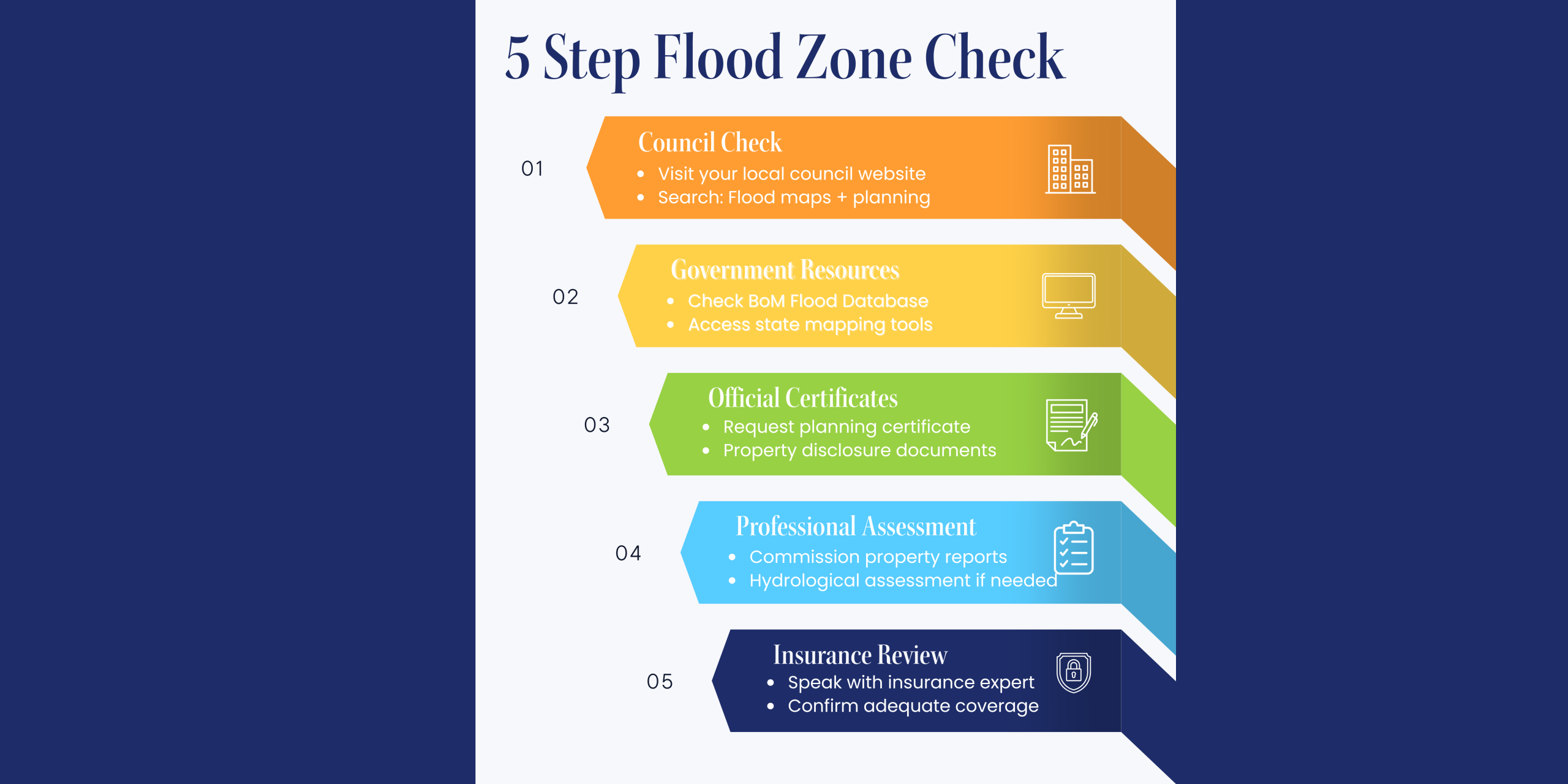
5 Step Flood Zone Check

Determining your property’s flood risk involves checking several authoritative Australian resources. Here’s your step-by-step guide:

1. Check Your Local Council’s Flood Maps

Your local council maintains the most detailed flood planning information for your specific area. Visit your council’s website and search for:

  • Flood planning maps
  • Flood studies
  • Development control plans (DCP)
  • Flood risk management plans

Most councils now offer interactive online mapping tools where you can enter your address and instantly see flood overlays. Major city councils including Brisbane City Council, Gold Coast City Council, City of Sydney, and Melbourne City Council all provide comprehensive online flood mapping.

2. Use the National Flood Information Database

The Australian Government’s Bureau of Meteorology provides access to flood information across Australia. Their website offers:

  • Historical flood records
  • Known flood-prone areas
  • Flood warning systems for your region
  • River height data and flood classifications

3. Access State Government Resources

Each state offers specific flood information tools:

New South Wales:

  • NSW Spatial Services’ SEED Portal (Sharing and Enabling Environmental Data)
  • NSW State Emergency Service (SES) FloodSafe website
  • Planning Portal NSW for flood planning information

Queensland:

  • Queensland Globe mapping tool
  • Queensland Reconstruction Authority flood maps
  • QFlood database for flood study information

Victoria:

  • Victorian Floodplain Management Strategy resources
  • Water.vic.gov.au flood information
  • Victorian Planning Authority flood overlays

South Australia:

  • SA Water flood mapping
  • DEW (Department for Environment and Water) flood resources

Western Australia:

  • Department of Water and Environmental Regulation flood mapping
  • Local government flood studies

Tasmania & Northern Territory:

  • Check your state’s emergency services or water management authority websites

4. Request a Section 10.7 Certificate (NSW) or Equivalent

When purchasing property, always obtain:

  • Section 10.7 Certificate (formerly Section 149) in NSW
  • Property Information Certificates in Queensland
  • Vendor Statements (Section 32) in Victoria
  • Property Disclosure Statements in other states

These official documents disclose whether the property is affected by flood planning controls, though they may not always show historical flooding.

5. Review Property Purchase Reports

Professional property reports often include flood risk assessments. Consider commissioning:

  • Building and pest inspections that note flood evidence
  • Surveyor reports showing elevation levels
  • Hydrological assessments for high-risk areas
  • Environmental reports that identify water-related risks

6. Talk to Locals and Real Estate Agents

While not a substitute for official data, long-term residents can provide valuable insights about historical flooding events that may not appear in official records. Ask about:

  • Previous flood events and their severity
  • How quickly water rises in the area
  • Seasonal flooding patterns
  • Which streets or areas are most affected

Understanding Australian Flood Risk Categories

Australian flood planning typically categorises risk into several levels. While terminology varies by council, here’s a general framework:

Flood Risk Category Description Typical Implications
Flood Planning Area (FPA) Area affected by floods up to the Probable Maximum Flood (PMF) May require flood-aware building design; insurance may be available with conditions
High Flood Risk Precinct Areas subject to regular flooding or deep/fast-flowing floods Significant building restrictions; insurance often difficult or expensive to obtain
Medium Flood Risk Areas where flooding is less frequent or less severe Some building controls apply; insurance generally available but may have higher premiums
Low Flood Risk Minimal flood probability based on historical data Few restrictions; standard insurance coverage typically available
Flood Free/Minimal Risk Above the PMF or no recorded flood history No flood-related building controls; standard insurance rates apply

Important Note: These categories can change as new flood studies are completed or climate patterns evolve. A property that was considered low risk a decade ago may now be classified as medium risk due to updated modelling or increased urban development affecting drainage.

What Your Flood Zone Means for Insurance

Understanding your flood zone directly impacts your insurance options and costs. Here’s what you need to know:

Standard Home and Contents Insurance

Most Australian home and contents insurance policies include flood cover as standard, but there are critical details to understand:

  • Policy definitions matter: Insurance companies use specific definitions of “flood” that may differ from common understanding. Typically, flood means water escaping from a natural watercourse, lake, or the sea.
  • Excess amounts: Properties in known flood zones typically carry higher excess amounts for flood claims. These will vary by location and level of risk. 
  • Premium costs: Flood-prone properties command higher premiums, sometimes 2-3 times standard rates.
  • Coverage limits: Some insurers cap flood damage payments or exclude certain items like landscaping or retaining walls.

What’s Considered a “Flood” vs Other Water Damage

Understanding insurance definitions is crucial:

  • Flood: Water escaping from rivers, creeks, lakes, or the sea
  • Storm damage: Wind-driven rain entering through damaged roofs or windows
  • Rainwater runoff: Water flowing over the ground surface (may not be covered under all policies)
  • Stormwater: Water from overwhelmed drainage systems (coverage varies)

Strata Insurance Complexities

For apartment and townhouse owners, flood coverage sits within strata insurance:

  • Individual owners should verify what the strata policy covers
  • Contents insurance remains your personal responsibility
  • Flood damage to common property is typically covered under strata policies
  • High-rise buildings may have different risk profiles than low-rise complexes

When Insurance May Not Be Available

In extreme high-risk areas, some insurers may:

  • Decline to offer flood coverage
  • Exclude flood from policies entirely
  • Offer coverage with prohibitively high premiums or excesses
  • Limit coverage to partial replacement rather than full rebuild

The Importance of Full Disclosure

When applying for insurance, you must disclose:

  • Knowledge of flood zoning or flood planning overlays
  • Previous flood damage to the property
  • Proximity to waterways, creeks, or drainage channels
  • Council flood planning controls affecting your property
  • Any flood mitigation measures you’ve installed

Failure to disclose can result in claim denial, even for non-flood-related claims.

Steps to Take if You’re in a Flood Zone

Discovering your property is in a flood zone doesn’t mean disaster, it means taking informed action:

1. Review Your Current Insurance

Contact your insurance broker or provider immediately to:

  • Confirm flood coverage is active and adequate
  • Understand your excess and coverage limits
  • Discuss mitigation measures that might reduce premiums
  • Ensure your sum insured reflects current replacement costs
  • Compare quotes from multiple insurers specializing in flood-prone properties

2. Develop a Flood Emergency Plan

Create a household flood plan that includes:

  • Emergency contact numbers (local SES, family members, insurance broker)
  • Evacuation routes and meeting points
  • Critical documents stored in waterproof containers or digitally backed up
  • Essential items ready to grab quickly (medications, valuables, photos)
  • Plans for pets and livestock
  • Knowledge of your home’s highest point for moving belongings

3. Consider Property Modifications

Flood-proofing measures can reduce risk and potentially lower insurance costs:

  • Raise electrical outlets, switchboards, and appliances above potential flood levels
  • Install flood-resistant materials on lower floors (tiles instead of carpet, water-resistant wall materials)
  • Improve drainage around your property with appropriate grading
  • Install backflow prevention devices on sewage and stormwater connections
  • Consider flood barriers, flood gates, or elevated foundations
  • Elevate valuable items and store them on upper floors
  • Install sump pumps in low-lying areas

4. Stay Informed

  • Register for your local council’s flood warning system
  • Download the SES or emergency services app for your state
  • Monitor weather forecasts during storm seasons (typically October-April in northern Australia)
  • Understand local flood classifications (minor, moderate, major)
  • Know the difference between flood watch, flood warning, and evacuation orders
  • Join community emergency preparedness groups or neighborhood networks

5. Maintain Regular Insurance Reviews

Meet with your insurance adviser annually to:

  • Update your coverage as property values change
  • Review recent flood studies or zone changes in your area
  • Ensure you’re adequately covered for rebuilding costs including demolition and site clearing
  • Explore premium reduction strategies through mitigation measures
  • Check if your insurer offers discounts for flood-resistant improvements

Common Flood Zone Myths Busted

Myth 1: “My property hasn’t flooded in 50 years, so I’m safe.” 

Reality: Climate change is altering historical patterns. The 2022 floods across Queensland and NSW affected areas that hadn’t flooded in recorded history. Areas that were once safe may now be at risk. Always check current flood mapping.

Myth 2: “Flood insurance is optional in Australia.” 

Reality: While you can technically decline it, doing so leaves you financially exposed to potentially catastrophic losses. With average flood claims exceeding $50,000, it’s a risk most property owners cannot afford.

Myth 3: “If I’m not near a river, I can’t flood.” 

Reality: Overland flow flooding can occur anywhere when drainage systems are overwhelmed. Properties in Brisbane’s western suburbs, Melbourne’s inner-city areas, and Sydney’s Eastern suburbs have all experienced flooding despite being kilometers from major waterways.

Myth 4: “Standard home insurance doesn’t cover floods.” 

Reality: Most Australian policies now include flood cover as standard following regulatory changes in 2013, though the definition of “flood” and coverage limits vary between insurers.

Myth 5: “If my property is in a flood zone, I can’t get insurance.” 

Reality: While challenging in extreme cases, most flood-zone properties can obtain coverage, though at higher premiums. Specialist brokers like Dudgeon Berry Insurance Group can help find coverage even for difficult properties.

Myth 6: “All water damage is covered the same way.” 

Reality: Insurance distinguishes between flood, storm damage, and rainwater runoff. The cause of water damage determines whether and how it’s covered.

Myth 7: “Apartments on upper floors don’t need flood coverage.” 

Reality: While your unit may not flood directly, common property damage affects all owners through strata insurance costs, and you may lose access to your home during flooding events.

Frequently Asked Questions

We’ve put together a comprehensive list of the most frequently asked questions we receive when it comes to flood insurance.

Is flood information publicly available for any Australian property? 

Yes. Council flood maps, planning certificates, and state government databases provide public access to flood risk information for most Australian properties. However, the level of detail varies between councils.

How often do flood zone maps get updated? 

This varies by council. Major updates typically occur after significant flood events or every 5-10 years when new flood studies are completed. Some councils in rapidly developing areas update more frequently. Always check the date on any flood map you’re reviewing.

Will being in a flood zone affect my property value? 

Potentially, yes. Properties in known flood zones typically sell for 5-20% less than comparable properties outside flood zones, with the discount increasing significantly after recent local flood events.

Can I challenge my property’s flood zone classification? 

Yes. If you believe your property has been incorrectly classified, you can commission an independent hydrological assessment and present evidence to your local council. However, official reclassification processes are complex, costly, and not always successful.

What’s the difference between a 1-in-100-year flood and a 1-in-20-year flood? 

These terms refer to probability, not frequency. A 1-in-100-year flood (also called the 1% Annual Exceedance Probability or AEP flood) has a 1% chance of occurring in any given year and represents a more severe flooding event. A 1-in-20-year flood has a 5% chance annually and is typically less severe. Confusingly, you could experience multiple “1-in-100-year” floods within a short period – the term describes probability, not a guaranteed timeframe.

Does flood zone designation mean my property will definitely flood? 

No. It indicates probability and risk based on modeling and historical data. Many properties in flood zones never experience actual flooding, while some properties outside mapped zones can flood due to unexpected circumstances or inadequate drainage infrastructure.

What should I do if I’m buying a property in a flood zone? 

Before purchasing, obtain professional advice including independent building inspections, flood risk assessments, and definitive insurance quotes. Factor potential insurance costs (which could be $2,000-$5,000+ annually) into your budget, and negotiate the purchase price accordingly. Never assume you can obtain affordable insurance without confirming it first.

Are there government grants available for flood mitigation? 

Some state and federal programs offer grants for flood resilience measures, particularly after declared disaster events. The Australian Government’s Disaster Ready Fund and various state-based programs provide funding for community flood mitigation. Check with your state’s emergency services or reconstruction authority for current programs.

Does flood insurance cover temporary accommodation if my home is uninhabitable? 

Most comprehensive policies include “alternative accommodation” or “additional living expenses” coverage, but there are limits (typically 10-20% of your building sum insured or 12-24 months). Check your policy details carefully.

What if I can’t afford flood insurance for my property? 

Speak with an experienced insurance broker who can help you explore options including higher excesses to reduce premiums, government assistance programs, or specialist insurers who may offer more competitive rates. Never go without insurance – the financial risk is too great.

Take Control of Your Flood Risk Today

Understanding your property’s flood zone status is a crucial step in protecting your most valuable asset. Whether you’re in Sydney, Melbourne, Brisbane, the Gold Coast, Adelaide, Perth, regional Australia, or anywhere in between, having the right information empowers you to make smart decisions about insurance, property improvements, and emergency preparedness.

At Dudgeon Berry Insurance Group, we’ve helped Australian property owners navigate complex flood insurance scenarios for the last 3 decades including the devastating 2022 Northern NSW floods. With offices serving Northern NSW, the Gold Coast, and clients Australia-wide, our expertise in regional and metropolitan flood risks, combined with our commitment to professional advice and personal service, means we’re here to find the right coverage for your unique situation, no matter where your property is located.

Need help understanding your flood insurance options? Contact our team today for a comprehensive review of your property insurance needs. We’ll help you secure the protection you need at a price that works for your budget, whether you’re in a high-risk flood zone or simply want peace of mind.

This article provides general information only and should not be considered personal advice. Flood zones, insurance requirements, and regulations vary significantly by location and individual circumstances. Always seek professional advice specific to your situation from qualified insurance advisers and local authorities.

Business Disaster Preparedness – Your Complete Guide

Business Disaster Preparedness Guide: How Australian SMEs Can Survive and Recover

Is Your Business Ready for Disaster? A Complete Preparedness Guide

Free Download: Get Your Business Disaster Preparedness Guide 

Every year, Australian businesses face the reality of natural disasters – flooding, cyclones, bushfires, and severe storms that can strike with little warning. The statistics are sobering: 40% of businesses never reopen after a major disaster, and 25% fail within the first year.

But here’s the good news: with proper preparation, your business doesn’t have to become a statistic. At Dudgeon Berry Insurance Group, we’ve worked with countless businesses through disaster recovery, and we’ve seen firsthand how preparation makes all the difference.

That’s why we’ve created a comprehensive Business Disaster Preparedness Guide – and we’re offering it as a free download to help local businesses protect what they’ve built.

Why Disaster Preparedness Can’t Wait

If you’re thinking “I’ll get to that later,” you’re not alone. Business owners are busy, and disaster planning often falls to the bottom of the priority list. But consider this:

  • Natural disasters don’t wait for convenient timing
  • Insurance alone isn’t enough – you need a plan
  • The cost of prevention is far less than the cost of recovery
  • Your family, employees, customers, and suppliers are counting on you
  • A solid plan can mean the difference between temporary closure and permanent shutdown

The time to prepare isn’t when warnings are issued – it’s right now, during the calm.

What’s Inside Our Free Disaster Preparedness Guide

We’ve packed this guide with practical, actionable advice based on real-world experience. Here’s what you’ll learn:

  1. Understanding Your Risk Profile

Not all businesses face the same threats. Our guide helps you assess:

  • Your specific geographic risks (flood zones, bushfire areas, storm vulnerability)
  • Business-specific vulnerabilities you might not have considered
  • Critical questions to identify your weakest points
  • How to prioritise your preparation efforts
  1. Building a Business Continuity Plan

A Business Continuity Plan is your roadmap for survival. We break down:

  • How to identify your critical business functions
  • Creating comprehensive emergency contact lists
  • Developing communication strategies for staff, customers, and suppliers
  • Setting up alternative operating arrangements (remote work, temporary premises, backup systems)

This isn’t theoretical – it’s a step-by-step framework you can implement immediately.

  1. Protecting Your Physical Assets

Your property, inventory, and equipment represent significant investment. Learn how to:

  • Implement property protection measures before disaster strikes
  • Safeguard inventory and equipment effectively
  • Protect critical business documents (both physical and digital)
  • Document your assets properly for insurance purposes
  1. Cyber Security in Disaster Preparedness

Most businesses don’t realise that natural disasters create cyber security vulnerabilities. Our guide covers:

  • Comprehensive data backup strategies
  • System security protocols to implement now
  • Post-disaster cyber risks to watch for (phishing, ransomware, scams)
  • How to maintain secure remote access during disruptions
  1. Managing Supply Chain Disruptions

Your business is only as resilient as your supply chain. Discover:

  • How to map and understand your supply chain vulnerabilities
  • Strategies for identifying and developing alternative suppliers
  • Proactive planning to prevent disruptions
  • What to do when disruption hits
  1. Operating with Limited Resources

Disasters often force reduced operations. We’ll show you:

  • Workforce planning strategies (cross-training, remote work, flexible arrangements)
  • How to prioritise services when you can’t do everything
  • Supporting staff wellbeing when they’re dealing with their own disaster impacts
  • Making tough decisions about what to maintain and what to pause
  1. Understanding Your Insurance Coverage

Having insurance isn’t enough – you need to understand it. Our guide explains:

  • Essential business insurance types and what they cover
  • Critical steps to take before disaster strikes
  • When to contact your insurance broker
  • How to maximise your coverage
  1. The Insurance Claims Process Demystified

We walk you through exactly what happens when you need to make a claim:

  • Immediate actions to take after damage occurs
  • What Dudgeon Berry Insurance Group does for you throughout the process
  • Your rights and responsibilities
  • How to document damage effectively
  1. Creating Your Emergency Action Plan

Timing is everything. Our guide includes specific checklists for:

  • 72 hours before impact
  • 24 hours before impact
  • During the event
  • After the event

These practical, actionable lists ensure nothing gets overlooked when time is critical.

  1. Financial Preparedness

Financial resilience is key to weathering any storm:

  • Building appropriate cash reserves
  • Accessing financial support after disasters
  • Understanding business interruption insurance
  • Maintaining financial relationships that help during crisis

Real Stories: Why Preparation Matters

We’ve seen businesses on both sides of the preparedness equation.

The Unprepared Business: A local retail store hit by flooding had no backup of customer data, no alternative suppliers identified, and unclear insurance coverage. They spent three months closed, lost 60% of their customer base, and ultimately had to close permanently.

The Prepared Business: A manufacturing company with a solid continuity plan was able to shift to their backup location within 48 hours of cyclone damage. They maintained 80% of operations, kept staff employed, and were back to full capacity within six weeks. Their insurance claim was processed smoothly because they had proper documentation.

The difference? One had a plan, the other didn’t.

How Dudgeon Berry Insurance Group Supports You

We don’t just sell insurance- we partner with you for the long term. When you work with us, you get:

Expert Guidance

  • Comprehensive insurance policy reviews
  • Risk assessment and mitigation advice
  • Business interruption planning support
  • One-on-one consultations tailored to your business

Claims Management That Works

Our approach to claims is different. We:

  • Complete claim forms with you to ensure accuracy
  • Lodge claims on your behalf with insurers
  • Follow up proactively to keep things moving
  • Lead with empathy – your peace of mind matters most
  • Stay involved from start to finish

Transparent Communication

You’ll always know:

  • What’s happening with your claim
  • What to expect next
  • Realistic timeframes (and we hold insurers accountable)
  • That your claim is in safe hands

Your Disaster Preparedness Checklist

Here’s a quick snapshot of what you should have in place (the full guide includes detailed checklists):

✓ Business Continuity Plan documented and tested
✓ Insurance coverage reviewed and understood
✓ All assets photographed and valued
✓ Critical documents backed up digitally and off-site
✓ Data backup systems verified
✓ Alternative suppliers identified
✓ Staff trained on emergency procedures
✓ Communication strategy established
✓ Remote work capabilities tested
✓ Emergency cash reserves established

How many boxes can you tick? If it’s not all of them, our guide will help you complete the rest.

Don’t Wait for Disaster to Strike

Storm season arrives every year. Bushfire warnings become reality. Floods happen. The question isn’t if a disaster will impact your area- it’s when, and whether your business will be ready.

The businesses that survive and thrive aren’t necessarily the lucky ones – they’re the prepared ones.

Download Your Free Guide Today 

We’ve put together this comprehensive Business Disaster Preparedness Guide because we believe in proactive protection, not reactive panic. This isn’t a sales pitch – it’s practical, actionable advice from insurance professionals who’ve seen what works … and what doesn’t!

Inside the guide, you’ll get:

  • 15+ pages of detailed disaster preparedness strategies
  • Practical checklists you can use immediately
  • Templates for emergency contact lists
  • Step-by-step Business Continuity Plan framework
  • Insurance coverage assessment tools
  • Real-world examples and case studies

Download your free copy now and start protecting your business today!

Take the Next Step

Reading the guide is a great start, but preparation requires action. Here’s what to do next:

  1. Download the Guide

Get your free copy and review it with your team. Identify your biggest vulnerabilities and prioritise your preparation efforts.

  1. Review Your Insurance Coverage

Not sure if you’re properly covered? We’re offering complimentary insurance reviews for local businesses. We’ll help you:

  • Identify gaps in your current coverage
  • Understand your policy terms in plain English
  • Explore additional coverage options if needed
  • Develop a claims strategy
  • Answer all your insurance questions – no obligation
  1. Create Your Business Continuity Plan

Set aside dedicated time to work through the planning frameworks in our guide. Involve your key staff members – they’ll have valuable insights into critical functions and potential vulnerabilities.

  1. Test Your Plans

A plan that sits in a drawer isn’t worth much. Schedule regular tests of your:

  • Data backup and recovery systems
  • Remote work capabilities
  • Emergency communication protocols
  • Alternative supplier arrangements
  1. Update Regularly

Your business changes, and your disaster preparedness should change with it. Review and update your plans at least annually, or whenever you:

  • Move locations
  • Add significant new assets
  • Change key suppliers
  • Hire new staff members
  • Expand services or products

Book Your Free Insurance Review

Ready to ensure your business is properly protected? Contact Dudgeon Berry Insurance Group today to book your complimentary insurance review. [link to calendar OR contact page OR email address]

During your review, we’ll:

  • Assess your current coverage against your actual risks
  • Explain your policy in clear, jargon-free language
  • Identify any coverage gaps
  • Discuss business interruption protection
  • Answer all your insurance questions
  • Provide recommendations tailored to your business

No pressure, no obligation – just expert advice from people who care about protecting local businesses.

Get in touch today:

Phone: 02 6621 3000
Email: hello@dudgeonberry.com.au
Website: dudgeonberry.com.au

The Bottom Line

Natural disasters are a reality of doing business in Australia. You can’t prevent them, but you can prepare for them.

The businesses that survive disasters aren’t the ones with the most resources, they’re the ones with the best plans. They’re the ones who took the time to prepare when skies were clear and operations were running smoothly.

Don’t wait until warnings are issued to start thinking about disaster preparedness. By then, it’s too late to build a comprehensive plan – you’re in reaction mode.

Start today. Download our free guide, review your insurance coverage, and create your Business Continuity Plan. Your future self (and your business) will thank you.

About Dudgeon Berry Insurance Group

At Dudgeon Berry Insurance Group, we’ve built our reputation on genuine relationships and exceptional service. We understand that insurance isn’t just about policies and premiums—it’s about protecting your livelihood, your employees’ jobs, and the business you’ve worked hard to build.

With extensive experience in business insurance and claims management, we know the unique challenges faced by local businesses. When disaster strikes, you won’t be dealing with a call center or an automated system—you’ll have a dedicated team that knows you, understands your business, and fights for the best possible outcome.

We make the claims process simple and transparent, because stress and confusion are the last things you need during a crisis.

That’s our commitment to you: the right coverage, clear advice, and exceptional support when you need it most.

This article is for general information purposes only. Every business has unique needs, and you should seek professional advice specific to your circumstances. Contact Dudgeon Berry Insurance Group for personalised guidance on protecting your business.

Ready to get started? Download your free Business Disaster Preparedness Guide and book your complimentary insurance review today.

Other Resources:

Queensland Government Disaster Preparedness

NSW Government Disaster Preparedness

Victoria Government Disaster Preparedness

South Australia Government Disaster Preparedness

Tasmania Government Disaster Preparedness

Western Australia Disaster Preparedness

Northern Territory Government Disaster Preparedness

Maintenance vs. Insurable Events: What Property Owners Need to Know

Maintenance vs. Insurable Events

What Property Owners Need To Know

Many property owners can think that their insurance policy covers every issue that arises with their building, equipment, or contents. Unfortunately, that assumption can lead to disappointment when a claim is denied. The truth is, there’s a big difference between maintenance issues and insurable events, and understanding that difference can save property owners significant time, money, and stress.

This article explains what sets these two categories apart, why insurers make this distinction, and how to avoid costly misunderstandings when protecting your property.

In This Article:

Understanding What Counts as Maintenance

Maintenance refers to the routine care and minor repairs that keep a property in good condition. These tasks are part of normal ownership responsibilities, similar to servicing a car to keep it running efficiently.

Examples of maintenance activities include:

  • Repainting walls or exterior surfaces to prevent deterioration.
  • Servicing or cleaning air conditioning systems to maintain performance.
  • Clearing gutters and downpipes to prevent water overflow.
  • Replacing seals, washers, and fittings as they wear out.

These tasks prevent gradual damage, extend asset life, and maintain value. However, they are the owner’s responsibility – not the insurer’s.

Most property and commercial insurance policies exclude losses caused by wear and tear, gradual deterioration, rust, corrosion, or lack of upkeep. From an insurer’s perspective, maintenance prevents foreseeable issues, whereas insurance responds to sudden, unforeseen events.

What Makes an Event “Insurable”?

An insurable event is typically sudden, accidental, and unexpected. It’s the kind of event you couldn’t have reasonably anticipated or prevented through routine maintenance.

For example:

  • A severe storm damages a roof or breaks windows.
  • A fire destroys part of a building or equipment.
  • A thief breaks in and steals valuable tools or inventory.
  • A burst pipe causes extensive water damage overnight.

Insurance exists to help you recover from these kinds of incidents – those outside your control. In contrast, ongoing maintenance issues like aging roofs, worn carpets, or rusting pipes are predictable and avoidable with proper care.

Clearing Up Common Misconceptions

Misunderstandings about what insurance covers are incredibly common. Here’s how to approach some of the most frequent ones:

  • “My roof is leaking, so insurance will pay for a new one.”
    Not necessarily. If the leak is caused by old age, lack of sealant, or neglected maintenance, it’s not covered. However, if a storm or falling debris caused sudden damage, that’s usually an insurable event
  • “Rust or corrosion on my pipes should be included.”
    Rust forms gradually through exposure and lack of maintenance. Because it’s not sudden or accidental, it falls under maintenance responsibilities, not insurance coverage.
  • “My policy covers everything, right?”
    Every insurance policy includes exclusions for wear and tear, mechanical breakdown, or inadequate upkeep. Always read your policy wording carefully, or better yet, discuss it with your broker.

Why the Difference Matters

Understanding the boundary between maintenance and insured events helps prevent unpleasant surprises during a claim. If maintenance issues are left unchecked, they can turn into major problems, often ones insurance will not pay for.

For example, failing to clean gutters might lead to water pooling and slowly seeping into walls. Over time, that moisture could cause rot or mold, both of which are considered maintenance-related. If that same wall were suddenly damaged by a storm or a burst pipe, however, the claim would likely be valid.

Staying on top of upkeep protects your assets, reduces safety risks, and helps ensure your insurance performs as intended covering genuine, unforeseen losses.

Smart Maintenance Practices for Property Owners

To get the best value from your insurance while keeping your property in top condition:

  1. Schedule regular inspections.
    Conduct seasonal or annual checks of roofs, gutters, plumbing, and electrical systems.
  2. Keep detailed records.
    Save receipts, service reports, and photos of upkeep. These records demonstrate due diligence if a claim ever arises.
  3. Act quickly on minor issues.
    Fix leaks, cracks, or damage early before they escalate. Insurers are more likely to view your claim favourably when you’ve maintained the property responsibly.
  4. Understand your policy exclusions.
    Each insurance provider structures coverage differently. Review exclusions with your Dudgeon Berry Insurance Group broker to avoid unwelcome surprises.
  5. Ask questions before assuming.
    Unsure whether an event is insurable? Contact Dudgeon Berry Insurance Group for expert guidance. An experienced broker can help clarify what your policy covers and recommend maintenance strategies that complement your insurance protection.

The Bottom Line

Insurance is a safeguard against the unpredictable, not a safety net for neglect. By understanding where maintenance ends and insurable events begin, property owners can maintain their assets more effectively and ensure claims proceed smoothly when genuine accidents happen.

Dudgeon Berry Insurance Group is committed to helping clients navigate this distinction with confidence. With the right combination of proactive maintenance and tailored insurance coverage, you can protect your property, avoid unnecessary costs, and gain peace of mind knowing you’re covered when it truly counts.

Business Insurance in Australia 2026 | Ultimate Guide

Why Business Insurance is Critical for Australian Businesses

Running a business means managing risk every day. From natural disasters and workplace accidents to cybercrime and legal disputes, unexpected challenges can threaten your financial stability — and even your survival.

Insurance is not just about compliance or “ticking a box.” It’s about protecting your livelihood, your employees, and your future. At Dudgeon Berry Insurance Group, we work with businesses across Australia to design tailored insurance solutions that keep operations secure –  whether you’re a small local business or a growing national enterprise.

👉 If you’re unfamiliar with the main insurance types available, read our companion guide: Types of Business Insurance.

How Much Does Business Insurance Cost?

The cost of business insurance varies widely depending on your industry, size, and risk profile. Common factors include:

  • Industry & activity: High-risk industries like construction or manufacturing often face higher premiums.
  • Location: Businesses in flood, bushfire, or cyclone-prone regions may pay more.
  • Size & turnover: A larger workforce or higher revenue generally means higher coverage needs.
  • Claims history: A clean record helps keep premiums lower.
  • Policy inclusions & limits: The broader the cover, the higher the cost

💡 Tip: Many business owners overpay for cover they don’t need — or worse, underinsure. A broker helps you strike the right balance.

Common Business Insurance Mistakes to Avoid

Even savvy business owners can slip up when it comes to insurance. Some of the most common mistakes we see include:

  • Underinsurance: Choosing policy limits that won’t cover a worst-case scenario.
  • “Set and forget” policies: Not updating cover when staff numbers, revenue, or locations change.
  • Overlooking exclusions: Flood, cyber, or pandemic coverage aren’t always standard.
  • Buying on price alone: The cheapest premium often comes with hidden gaps.

By working with a broker, you can avoid these pitfalls and ensure your business is protected properly.

Industry-Specific Risks and Coverage Needs

Every business is different which means every insurance program should be different too. Some examples:

  • Construction: Public liability and workers’ compensation are essential, but equipment and tool cover are often overlooked.
  • Retail & E-commerce: Stock protection and cyber insurance are increasingly critical.
  • Hospitality & Tourism: Business interruption is vital when closures from floods, fires, or power outages occur.
  • Agriculture: Weather events, livestock, and machinery are key exposures.

At Dudgeon Berry, we take the time to understand your industry and customise cover accordingly.

Not sure what policies apply to your business? Start by reviewing our Types of Business Insurance article for a breakdown of essential covers.

Business Insurance in 2026: Key Trends to Watch

The landscape of risk is evolving, and so is the insurance market. Here are some of the biggest shifts business owners should know about:

  • Cybercrime surge: SMEs are now a primary target, with phishing and ransomware attacks on the rise.
  • Climate-driven risks: Floods, bushfires, and cyclones are reshaping insurance pricing in many regions.
  • Parametric insurance growth: These innovative policies pay out automatically when certain conditions are met (e.g., rainfall levels), providing faster support.
  • Regulatory changes: State-based reforms are reshaping workers compensation and insurance obligations.

Keeping ahead of these changes ensures your insurance is future-proof, not just fit for today.

Choosing the Right Insurance Partner

Business insurance can be complex — and no two policies are the same. That’s where a broker makes all the difference.

At Dudgeon Berry Insurance Group, we:

  • Compare policies from multiple insurers.
  • Translate fine print into plain English.
  • Tailor coverage to your unique risks.
  • Provide claims support when you need it most.

We’re here to make insurance simple, so you can focus on running your business.

Insurance is more than protection – it’s peace of mind. The right strategy ensures that when the unexpected happens, your business can survive, recover, and grow stronger.

At Dudgeon Berry Insurance Group, we partner with businesses nationwide to deliver tailored, cost-effective insurance solutions.

👉 Talk to us today to review your business insurance for 2025.

Why Use An Insurance Broker

Why Use An Insurance Broker

Navigating the world of insurance can often feel overwhelming, with countless policies, providers, and fine print to consider. Whether you’re safeguarding your business, personal assets, or agricultural operations, finding the right coverage is essential to protecting what matters most – this is where working with an Insurance Broker can save you precious time, hundreds or not thousands of dollars, and give you peace of mind.

What is an Insurance Broker

An insurance broker is a professional intermediary who works on behalf of clients to secure the best insurance policies for their unique needs.

Unlike insurance agents, who represent specific insurers, brokers operate independently and negotiate with multiple providers to find tailored solutions. Insurance Brokers assess risks, provide expert advice, and support clients throughout the insurance lifecycle, including claims management.

In Australia, insurance brokers are licensed by the Australian Securities and Investments Commission (ASIC) and often hold additional qualifications that ensure they adhere to high standards of professional practice. Our role as an insurance broker is essential for individuals and businesses seeking comprehensive coverage without the complexity of navigating insurance markets alone.

The Benefits of Using an Insurance Broker

Choosing an insurance broker offers several advantages:

Expertise and Guidance: Brokers possess in-depth knowledge of insurance products and industry trends. They help clients make informed decisions by explaining complex terms and identifying the best coverage options.  They can apply their years of experience and extensive industry contacts to provide you with the right insurance solution for your individual needs.

Personalised Service: Brokers take the time to understand our clients’ specific needs, tailoring policies to ensure comprehensive protection without unnecessary costs. As Insurance Brokers, we work for you, our clients – and not the insurance companies.

Access to Multiple Providers: Insurance Brokers have access to a wide range of insurers, including options not available to the general public. This enables us to secure competitive rates and customised solutions.

Claims Advocacy: In the event of a claim, we act as advocates for our clients, navigating the process and negotiating with insurers to achieve favourable outcomes.

Time, Cost & Sanity Savings: By handling research, negotiations, and administrative tasks, brokers save clients valuable time while often securing cost-effective policies. We also present our clients with insurance coverage that suits your individual needs so you can be confident you have the protection you need.

Why Choose Dudgeon Berry Insurance Group

Dudgeon Berry Insurance Group is a trusted name in insurance broking, offering professional advice and personalised service. As part of the Community Broker Network (CBN)—Australia’s largest general insurance broker network—Dudgeon Berry Insurance Group benefits from extensive resources and connections with over 300 insurance markets. This ensures access to tailored solutions for businesses, individuals, and agricultural needs.

  • Award-Winning Expertise: With over 85 years of combined experience, Dudgeon Berry has been recognised for its excellence in delivering market-leading insurance broker services.
  • Comprehensive Coverage: From business portfolios to personal assets like home and motor vehicles, Dudgeon Berry provides a wide range of insurance solutions tailored to individual requirements
  • Claims Support: The team offers end-to-end claims management, ensuring clients receive timely resolutions while minimising stress.
  • Community-Focused Approach: Headquartered in Lismore, NSW, Dudgeon Berry has deep ties to the community. Our expertise in agricultural insurance reflects their commitment to supporting local farmers and businesses.  
  • Serving Australia: Expanding our footprint, we now have a Gold Coast office, along with clients spread across Australia so no matter what your insurance requirements are, we are able to provide you with the exceptionally high level of service that Dudgeon Berry Insurance Group has become known for.

Partnering with Community Broker Network (CBN)

Being part of CBN allows Dudgeon Berry Insurance Group to deliver unparalleled service. CBN brokers are known for their professionalism, industry knowledge, and dedication to client satisfaction. The Dudgeon Berry Insurance Group insurance brokers undergo continuous professional development through initiatives like the CBN Academy, ensuring we remain at the forefront of emerging risks and industry changes.

CBN’s network empowers brokers with tools to provide tailor-made solutions for small businesses and individuals alike. Whether its risk assessment or claims negotiation, CBN brokers prioritise client interests above all else.

Your trusted Insurance Broker | Dudgeon Berry Insurance Group

Navigating the complexities of insurance can be daunting—but with Dudgeon Berry Insurance Group by your side, you gain a trusted partner dedicated to protecting your assets and future. Combining award-winning expertise with access to CBN’s extensive network, Dudgeon Berry ensures personalised service that meets your unique needs. Whether you’re safeguarding your business or personal assets, our insurance brokers deliver peace of mind through tailored solutions and ongoing support.

Take the first step today—contact Dudgeon Berry Insurance Group for expert advice that puts your interests first!

Cyber Security Insurance

Cyber Security Insurance

Safeguarding Your Business in the Digital Age : The Critical Importance of Cyber Security Insurance

In today’s interconnected world, businesses of all sizes face an ever-growing threat from cyber attacks. As technology advances, so do the methods and sophistication of cybercriminals. From data breaches to ransomware attacks, the potential for severe financial losses, operational disruptions, and irreparable damage to your company’s reputation is a reality that cannot be ignored. At Dudgeon Berry Insurance Group, we understand these risks and are committed to helping you protect your business with comprehensive cyber insurance coverage.

In This Article:

The Rising Tide of Cyber Threats

The digital landscape is fraught with dangers. In recent years, we’ve witnessed a dramatic surge in cyber incidents targeting businesses across all sectors. Consider these sobering statistics:

These numbers underscore the critical need for robust cyber security measures, including comprehensive insurance coverage.

Why Cyber Insurance is Non-Negotiable

    1. Financial Protection

The financial impact of a cyber incident can be devastating. Cyber insurance provides a crucial safety net, covering a wide range of expenses:

      •  Data recovery and system restoration costs
      •  Legal fees and compensation claims
      •  Regulatory fines and penalties
      •  Public relations expenses to manage reputational damage

Without adequate coverage, these costs could potentially bankrupt a business, especially smaller enterprises with limited resources.

      1. Business Continuity

In the aftermath of a cyber attack, every minute of downtime translates to lost revenue and productivity. Cyber insurance plays a vital role in ensuring business continuity:

      •  Provides funds for immediate incident response
      •  Covers costs of temporary infrastructure and equipment
      •  Compensates for lost income during the recovery period

This support enables businesses to recover quickly and minimise the long-term impact of an attack.

      1. Reputation Security

In today’s digital economy, trust is currency. A cyber breach can severely damage client confidence and tarnish your brand’s reputation. Having cyber insurance in place demonstrates:

      • Your commitment to protecting client data
      • Proactive risk management practices
      • Financial stability to weather cyber incidents

This preparedness can go a long way in maintaining stakeholder trust and safeguarding your reputation.

      1. Specialised Expertise

Navigating the complex world of cyber security can be overwhelming. At Dudgeon Berry Insurance Group, we offer more than just insurance policies. Our team can provide::

      •  Expert guidance on risk assessment and management
      •  Tailored insurance solutions based on your specific needs

This expertise ensures that you’re not just insured, but truly protected against the evolving landscape of cyber threats.

Comprehensive Coverage for Modern Risks

We will work with you to find the right cyber security insurance solution for your business ensuring you’re covered for a range of digital risks, including:  

      •  Data breaches and privacy violations
      •  Ransomware and extortion attempts
      •  Business email compromise
      •  Denial of service attacks

The Cost of Inaction

While some businesses may hesitate to invest in cyber insurance due to perceived costs, the potential financial impact of a cyber incident far outweighs the price of coverage. Consider these scenarios:

#1 A small e-commerce business suffers a data breach, exposing customer credit card information. Without insurance, they face crippling legal fees and compensation claims.

#2  A mid-sized manufacturing firm falls victim to a ransomware attack, halting production for days. Cyber insurance could have covered the ransom payment and system restoration costs, minimising downtime and financial losses.

These examples illustrate how cyber insurance can mean the difference between a manageable setback and a business-ending catastrophe.

Taking Action: Securing Your Digital Future

As cyber threats continue to evolve and proliferate, the question is no longer if your business will face an attack, but when. Proactive measures, including comprehensive cyber insurance coverage, are essential for survival in the digital age.

At Dudgeon Berry Insurance Group, we’re committed to helping you navigate these challenges. Our team of experts will work with you to:

      1. Assess your current cyber risk exposure
      2. Identify potential vulnerabilities in your systems and processes
      3. Develop a tailored insurance solution that addresses your specific needs
      4. Provide ongoing support and guidance to enhance your overall cyber security posture

Don’t wait for a cyber incident to highlight the gaps in your protection. Contact Dudgeon Berry Insurance Group today to learn how our cyber security insurance solutions can safeguard your business, your reputation, and your future in the digital landscape.

Remember, in the world of cyber security, preparation is not just prudent – it’s essential. Let us help you build a resilient defense against the cyber threats of today and tomorrow.

Individuals and businesses can report cybercrime through the Australian Cyber Security Centre Report Cyber page.

Holiday Rental Insurance

Protecting Your Short-Term Holiday Rental Property: A Complete Insurance Guide

The rise of platforms like Airbnb and Stayz has transformed the way property owners generate income from their property investments. However, with this opportunity comes unique risks that standard home insurance policies don’t typically cover. In this comprehensive guide, we’ll explore why specialised short-term holiday rental insurance is essential and how Dudgeon Berry Insurance Group can help protect your investment.

Understanding Short-Term Rental Insurance

Short-term rental insurance is specifically designed to protect property owners who rent out their properties for brief periods, typically less than 90 days. This specialised coverage bridges the gap between standard homeowner’s insurance and traditional landlord insurance, offering protection tailored to the unique risks associated with short-term letting.

Who Needs Short-Term Holiday Rental Insurance?

This insurance is essential for:

  • Property owners listing on platforms like Airbnb or Stayz
  • Holiday home owners who rent out their properties
  • Investors with properties used for short-term accommodation
  • Homeowners who occasionally rent out rooms or their entire property

Why Standard Insurance Isn’t Enough

Many property owners mistakenly believe their standard home insurance policy provides adequate coverage for short-term rentals. However, most regular policies explicitly exclude business activities, including short-term letting. This gap in coverage could leave you exposed to significant financial risks.

Key Risks Covered by Short-Term Rental Insurance

  1. Property Damage
  • Accidental or malicious damage by guests
  • Theft of contents and personal belongings
  • Storm, fire, and natural disaster damage
  • Vandalism
  1. Liability Protection
  • Guest injuries on the property
  • Third-party property damage
  • Legal expenses and defense costs
  1. Loss of Income
  • Cancellations due to covered events
  • Property damage requiring repairs
  • Loss of booking income due to an insured event such as a fire, storm, cyclone 
  1. Additional Protections
  • Professional cleaning expenses
  • Key replacement services
  • Chemical contamination – manufacturing storage or distribution of any controlled drug (IMPORTANT: check your wording if you have this cover)

Top Tips if renting your property out over the holidays!

Insurance Council Australia provides some great tips for homeowners who rent out their properties during holiday periods:

  • Check your building and contents insurance policy details prior to advertising on short-stay holiday rental platforms. If the policy doesn’t cover short-term rental, you must look for a specialty policy that protects both home and contents while paying guests are staying. 
  • Be aware that rental platform’s host protection insurance may not cover all the potential damages you expect. 
  • Reduce the risk of theft by removing valuables during the short-term stay. 
  • Check strata rules, tenancy agreements, and local council laws because these may prohibit short-stay holiday rental. 

Why Professional Insurance Advice Matters

Navigating the complexities of short-term rental insurance requires expertise. This is where Dudgeon Berry Insurance Group’s experience becomes invaluable. As trusted insurance professionals with deep industry knowledge, we can:

  • Assess your specific risks and circumstances
  • Identify coverage gaps in existing policies
  • Recommend appropriate insurance solutions
  • Help you understand policy terms and conditions
  • Provide ongoing support and claims assistance

Making the Right Choice with Dudgeon Berry Insurance Group

At Dudgeon Berry Insurance Group, we understand that every short-term rental property is unique. Our approach involves:

  1. Comprehensive Risk Assessment: We evaluate your property’s specific characteristics, location, and rental arrangements to determine appropriate coverage levels.
  1. Tailored Solutions: We work with leading insurers to provide customised insurance solutions that match your needs and budget.
  1. Expert Guidance: Our experienced team helps you understand your policy options and makes recommendations based on your circumstances.
  1. Ongoing Support: We provide continuous support, including claims assistance and regular policy reviews to ensure your coverage remains appropriate.

Taking Action to Protect Your Investment

Don’t wait for an incident to discover gaps in your insurance coverage. Contact Dudgeon Berry Insurance Group today to ensure your short-term rental property is properly protected. Our team of professional insurance brokers will:

  • Review your current insurance arrangements
  • Identify potential risks and coverage gaps
  • Provide competitive quotes from leading insurers
  • Guide you through the insurance process

Contact Dudgeon Berry Insurance Group at 02 6621 3000 or email hello@dudgeonberry.com.au to discuss your short-term holiday rental insurance needs. With over 85 years of combined experience, we’re here to help you protect what matters most.

Remember, the right insurance coverage isn’t just about meeting legal requirements – it’s about ensuring peace of mind while running your short-term rental business successfully.


Why You Need Travel Insurance

Travel Insurance: Your Essential Guide to Worry-Free Adventures

When planning your next trip, travel insurance may not be the first thing on your mind. However, it’s a crucial consideration that can save you from significant financial and emotional stress if things don’t go according to plan. At Dudgeon Berry Insurance Group, we believe in helping our clients make informed decisions about their insurance needs. Let’s explore some common questions about travel insurance to help you understand its importance and benefits.

Is Travel Insurance a Must?

While travel insurance isn’t legally required for most destinations, it’s highly recommended for any trip, domestic or international. The unpredictable nature of travel means that even the most meticulously planned trips can encounter unexpected issues. From flight cancellations and lost luggage to medical emergencies abroad, travel insurance provides a safety net that can protect you financially and offer peace of mind.

Consider this: if you fall ill in a foreign country, medical costs can quickly escalate into tens of thousands of dollars. Without insurance, you’d be responsible for these expenses out of pocket. Travel insurance acts as a buffer against such unforeseen circumstances, making it an essential part of your travel plans.

What Are the Benefits of Travel Insurance?

Travel insurance offers a wide range of benefits that can prove invaluable during your journey:

  • Medical Coverage: This is perhaps the most critical benefit. It covers emergency medical expenses, hospital stays, and even medical evacuation if necessary.
  • Trip Cancellation/Interruption: If you need to cancel or cut short your trip due to covered reasons (such as illness, injury, or a death in the family), you can recoup non-refundable expenses.
  • Lost or Delayed Baggage: Compensation for lost, stolen, or delayed luggage can help you replace essential items.

Top Tip:  if taking expensive pieces of jewellery or equipment with you on your holiday or business trip, be sure to itemise these on your policy if you’d like them to be covered.  It will generally increase your premium however it will also bring you enormous peace of mind.

  • Travel Delays: Coverage for additional accommodation and meal expenses if your trip is delayed due to covered reasons.
  • 24/7 Assistance: Many policies offer round-the-clock support for emergencies, helping you navigate unfamiliar healthcare systems or assisting with travel arrangements.
  • Personal Liability: Protection against claims made against you for accidental injury to other people or damage to their property.

What Type of Travel Insurance Do I Need?

The type of travel insurance you need depends on various factors, including your destination, the nature of your trip, and your personal circumstances. At Dudgeon Berry Insurance Group, we offer tailored policies to suit different needs:

  • Single Trip Insurance: Ideal for one-off vacations or business trips.
  • Annual Multi-Trip Insurance: Perfect for frequent travellers, covering multiple trips within a year.
  • Backpacker Insurance: Designed for long-term travellers or those on working holidays.
  • Adventure Sports Coverage: For those engaging in high-risk activities like skiing or scuba diving.
  • Medical Conditions:  If required, bespoke pre-existing medical coverage.

When choosing a policy, consider factors such as your health, the activities you’ll be undertaking, and the value of your belongings. Our team can help you assess your needs and find the right coverage.

Does Travel Insurance Coverage Differ by Country?

Yes, travel insurance coverage can vary depending on your destination. Some countries have higher healthcare costs, which may be reflected in your premium. Additionally, certain countries may be considered higher risk due to factors like political instability or prevalent diseases, potentially affecting coverage or requiring additional riders.

It’s crucial to disclose your exact itinerary when purchasing insurance to ensure you’re adequately covered for all destinations. At Dudgeon Berry Insurance Group, we can provide guidance on country-specific considerations and help you choose a policy that offers appropriate coverage for your entire journey.

Is It Worthwhile Getting an Annual Travel Policy?

If you travel frequently – typically more than 2-3 times a year – an annual multi-trip policy can offer better value and convenience. Benefits include:

  1. Cost-Effectiveness: Often cheaper than purchasing separate policies for each trip.
  2. Convenience: No need to arrange new insurance for every journey.
  3. Continuous Coverage: You’re always protected, even for last-minute trips.

However, annual policies may have limitations on trip duration or may not cover certain high-risk activities. Our team can help you weigh the pros and cons based on your travel habits and needs.

Do I Need Travel Insurance If I Have Coverage Through My Credit Card?

While some credit cards offer travel insurance as a perk, it’s essential to carefully review the coverage provided. Credit card travel insurance often has significant limitations:

Limited Coverage: May only cover trips purchased with the card and might have lower benefit limits.

Restricted Duration: Often caps on the length of trips covered.

Exclusions: May not cover pre-existing conditions or certain activities.

Activation Requirements: Some require you to meet specific criteria to activate the coverage.

We recommend comparing your credit card coverage with standalone travel insurance policies. In many cases, a comprehensive travel insurance policy from a travel insurance provider can offer more extensive protection and higher benefit limits.

Protecting Your Journey 

Travel insurance is more than just a safety net – it’s an investment in your peace of mind. By protecting yourself against the unexpected, you can fully enjoy your travels without worrying about potential financial setbacks.

At Dudgeon Berry Insurance Group, we’re committed to helping you find the right travel insurance solution. Our experienced team can guide you through the options, explain policy details, and ensure you have the coverage that best suits your needs and budget.

Don’t let uncertainty cloud your travel plans. Contact Dudgeon Berry Insurance Group today to explore our travel insurance options and embark on your next adventure with confidence.  Learn more about our travel insurance offerings and how we can help protect your journey.